


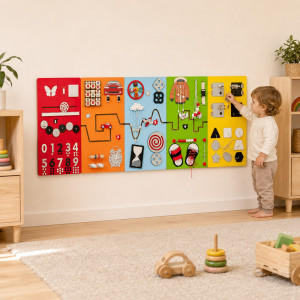


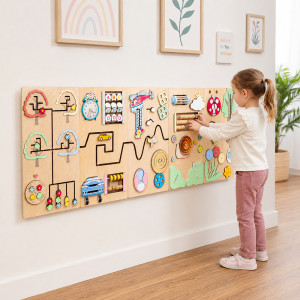


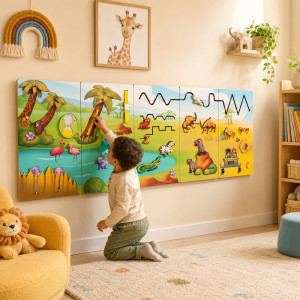


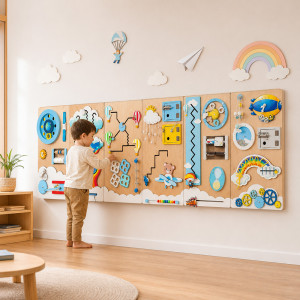

Sensory wall panels are wall-mounted, interactive learning tools that help children develop fine motor skills, hand-eye coordination and problem-solving, while encouraging sensory exploration through hands-on play. Unlike traditional toys, they stay mounted on the wall - creating an engaging activity area without taking up floor space. Each panel combines tactile elements, moving parts, and in some models lights and sound. This gives children a reason to explore and keep exploring.
Handcrafted by BumbleBeeSmart for classrooms, therapy rooms, waiting areas and home playrooms, they provide screen-free, hands-on activities for children across different developmental stages. Several children can use different sections of the same wall-mounted installation at once, without one child blocking another's access. That's part of why they show up so often in shared spaces, not just single-child bedrooms.
Sensory wall panels by audience
Different settings need different panels - calmer palettes for memory care, classroom-ready sizing for schools, clinical durability for therapy rooms. Browse by who you're outfitting for:
How is this different from a busy board
The terms overlap in everyday use, and many of our products answer to both names. The practical difference is scale: a busy board is usually a single panel or small set built around one activity mix. A collection here is built to become part of a larger installation - multiple panels, themed sets, or a full wall system for a shared space. If you're outfitting one bedroom or a single calm corner, see our busy boards collection. If you're planning a larger installation across a classroom, waiting room or facility, you're in the right place. For a full walkthrough of sizing, materials and layout planning, see our guide to how to choose the right sensory wall panels.
In practice, the line blurs at the edges. A single large panel can outgrow the "busy board" label once it's sized for a shared wall, and a small multi-panel set can function like an oversized busy board in a home playroom. Rather than picking a category first, it's usually more useful to start from the space. Measure the wall and decide how many children need access at once. That determines whether a compact board or a multi-panel installation fits better.
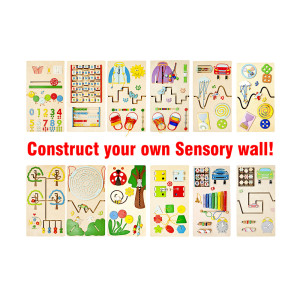
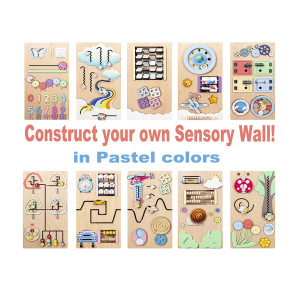
Not sure what fits your space? Send us your wall dimensions and we'll recommend a panel count and layout that works for the room, not just the wall. Or use our DIY sensory wall builder (also available in pastel colors) to plan an exact-fit modular wall yourself.
Why choose this format
The value isn't just keeping a child occupied. A fixed, wall-mounted activity area gives a child the same reliable spot to return to every day. That matters more than it sounds. Repeated practice on the same mechanisms builds fine motor skills, not a single session with a new toy. Each of the areas below draws on a different part of that repeated, hands-on interaction.
- Develop fine motor skills - turning gears, moving sliders, opening locks and manipulating tactile elements strengthen finger muscles and coordination
- Improve focus and concentration - interactive activities keep children engaged for noticeably longer periods than a passive toy
- Support sensory development - different textures, sounds, lights and movements stimulate multiple senses at once
- Encourage independent learning - Montessori-inspired activities let children explore and solve problems on their own, without an adult directing each step
- Save space - a wall-mounted installation creates an activity area without cluttering the floor, which matters most in a room that already has furniture and foot traffic to work around
Themes and configurations
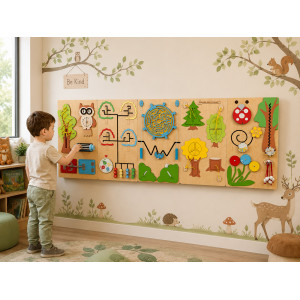
Panels come in a wide range of themes - safari, forest, sea, mountains, space, national park and more (see our guide to choosing a theme if you're weighing a few options). Natural wood and Scandinavian palettes suit calmer settings. Configurations range from a single accent panel to full multi-panel walls, in hand-painted, printed or wooden finish base finishes. Every panel is available for custom color, theme and layout on request.
Theme isn't purely decorative. A recognizable animal or scene gives a hesitant child something to name and point at first. That's often what gets a reluctant child to approach the wall in the first place. Sea and safari themes are consistently the most requested for nurseries and daycare settings. That first point of recognition matters more there than with an older child who's already comfortable exploring on their own. For settings that need to stay visually neutral, a natural wood or unpainted finish gives the same interactive mechanisms without a themed scene layered on top.
Safe and durable construction
Material choice matters more in a shared installation than it does for a single home toy. We build every panel from birch plywood rather than MDF or particleboard. It holds hardware more securely over repeated use and resists moisture better in a frequently-cleaned room. Pressed-wood composites can flake or swell after a year of daily handling; birch plywood doesn't. Interactive elements, locks, gears, sliders and latches, are mechanically fastened with screws and bolts rather than glued on. That's the difference between a panel that survives a classroom year and one that starts losing pieces within months.
- Handcrafted from birch plywood with a non-toxic, water-based lacquer topcoat across every finish - painted, printed or unpainted
- Smooth edges and rounded corners on preschool and toddler sets
- Durable construction built for high-traffic, shared environments
- Handcrafted, built for long-lasting educational use
Panels with LED lights or sound effects include a standard DC 5V 3A power supply. Multiple panels can be connected together or installed individually, and a cable run can usually be hidden behind the panel or routed along a baseboard rather than left exposed across the wall. Already chosen a panel? Our installation and care guide walks through mounting hardware, wall types and setup step by step. For full CPSC materials standards, mounting safety and inspection guidance, see our sensory wall panel safety guide, linked below.
Planning a custom installation?
Every learning environment is different. Select themes, colors, activities and layout to create a sensory wall that matches your space and goals - from a single accent panel to a full facility installation.
Frequently asked questions
What is a sensory wall?
A sensory wall is a wall-mounted activity installation designed to encourage hands-on learning, sensory exploration and fine motor development. It typically combines several panels with interactive elements. Gears, mazes, spinners, lights, shape sorters and tactile activities work together in one shared activity area. Because it's fixed to the wall rather than sitting on furniture, it holds up to more hands per day than a standalone toy typically does.
What age is this suitable for?
Suitable for children from about 12 months through elementary school age. Younger children typically engage with simpler tactile and cause-and-effect activities, while preschool and school-age children can use more complex latches, mazes, gears and multi-step activities.
How many panels do I need for my wall?
Our standard sets use 35×65cm (14×26") panels. A standard 5-panel set totals 175cm (69") wide; larger themed sets run 6-10 panels, 210-350cm (83-138") wide. For an exact fit, our DIY modular format lets you divide your wall width by 35cm (14") to find your panel count, or send us your dimensions and we'll recommend a layout.
Where can these be installed?
Commonly in homes, classrooms, daycares, libraries, pediatric clinics, therapy centers, waiting rooms and children's museums. The wall-mounted design saves floor space while creating a shared activity area for several children at once.
Are these beneficial for children with autism?
Many schools, therapy centers and families use them as part of a sensory play environment, and interactive activities can provide structured opportunities for hands-on engagement. Every child's needs are different, so activity selection should reflect individual preferences and goals. See our dedicated sensory wall panels for autism collection, linked above.
Can I customize one?
Yes. We build custom sensory wall panels with personalized themes, colors, activities and modular layouts. This works for homes, schools, healthcare facilities and public spaces, and covers everything from a single custom panel added to a standard set to a fully bespoke multi-room installation. Reach out to discuss your project.
Looking for a version designed for older adults? Our sensory wall panels for adults, linked above, are made for dementia and memory care, in homes and care settings.